

What is ASL in text? If someone sends you a short message saying ASL, you might wonder what it means. Is it a greeting, a question, or internet slang? This guide explains its meaning, origin, real chat examples, and how to respond confidently.
Here you’ll learn what ASL in chat really means, where it came from, and why some people still type it today. You’ll also see real conversation examples, common mistakes, and smart ways to reply. Short examples make each point easy to follow, and every section stays practical. Quick answers come first. Whether you want to answer politely, joke back, or protect your privacy, you’ll find a response that fits. Let’s break it down in simple terms so you never feel stuck again.
What Is ASL in Text and What Does It Mean?
ASL in chat usually means age, sex, location. It’s a quick way to ask three basic questions at once: How old are you? Are you male or female? Where do you live?
People used it mostly in online chat rooms, direct messages, and early instant messaging. Instead of typing a long question, they sent three letters and waited for a reply.
You might see it like this:
- “Hey, ASL?” means “How old are you, what’s your gender, and where are you from?”
- “New here? ASL?” means “Please introduce yourself.”
Context decides everything, though. In a conversation about signing or Deaf culture, ASL means American Sign Language. Always read the surrounding messages before you answer.
What Do the Letters A, S, and L Stand For?
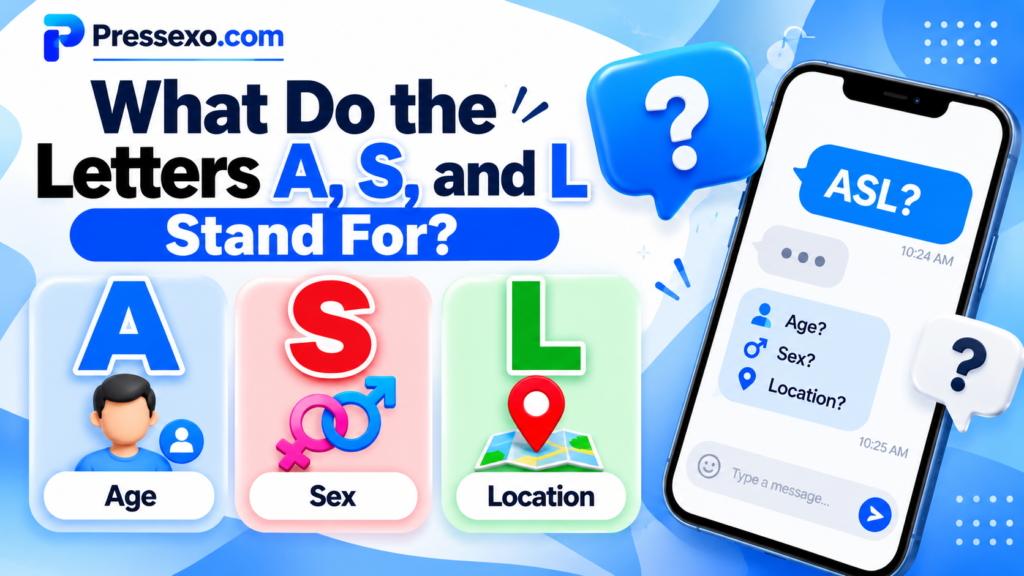
Each letter in ASL stands for one piece of personal information.
- A = Age: How old are you?
- S = Sex: Traditionally asks whether you’re male or female. Many people now read it as gender.
- L = Location: Where do you live, or where are you right now?
Notice that the question doesn’t ask for exact details. You can answer with a rough age range, a country, or a city. Many people reply in a short pattern such as “24, female, Dubai.”
Because the S can feel outdated, some modern chatters skip it and just ask about age and location. If you’re unsure which meaning someone intends, ask politely. A quick clarification prevents awkward moments.
Where Did ASL in Chat Come From?
ASL became popular in the early days of online chat. During the 1990s and early 2000s, people met strangers in public chat rooms and instant-messaging services. Conversations moved fast, so users invented shortcuts.
Typing three letters was easier than writing a full question. It also gave strangers a quick way to size up a new conversation partner.
Over time, the abbreviation became tied to flirting and anonymous chatting. It also showed up in jokes and pop culture references, which is why many people still recognize it today.
Knowing this history helps you judge the tone behind the message. The American Sign Language meaning has a completely separate history. The two meanings simply share the same letters.
ASL in Chat Examples With Real Conversations
Seeing real chats makes the meaning easier to remember. Here are three common situations.
Text message
- “Hey, you seem fun. ASL?”
- “22, female, Sydney. You?”
Instagram DM
- “Loved your travel post. ASL?”
- “31, male, Toronto.”
Joking reply
- “ASL? Are we back in 2005? 😂”
- “Ha, fair. Where are you from?”
In the first two chats, the sender sincerely wants basic details. In the third, the reply jokes about how old-fashioned the abbreviation sounds. Notice that every answer stays short and casual. That’s the usual tone for this slang.
You can also use these as templates. Swap in your own details, keep the message brief, and match the other person’s energy. If the chat feels friendly, answer openly. If it feels pushy, share less.
Why Do People Ask ASL in Chat?
People usually ask ASL for simple reasons. They want a fast way to learn who they’re talking to.
Common motives include:
- Curiosity about a new person in a group chat
- Checking whether someone is a similar age
- Finding out if someone lives nearby or in a friendly time zone
- Starting a flirty or friendly conversation
Still, the question can feel abrupt. Strangers asking for personal details right away may seem intrusive, especially online. Modern profiles often show some of this information already, so many users prefer gentler openers.
Understanding the motive helps you decide how to reply. A friendly tone usually means harmless curiosity. A pushy tone suggests you should protect your details.
How ASL Is Used on Different Platforms
Context shapes how ASL sounds, so it helps to know where you see it.
- Social media DMs: Often a quick opener, though it’s less common now than direct questions.
- Friends and groups: Usually playful, sometimes used to welcome newcomers.
- Dating chats: Historically common, but it can feel too direct early on.
- Gaming lobbies: May appear as a casual question between teammates.
- Work or school: Avoid it. Ask clearly and politely instead, such as, “Which city are you based in?”
A good rule is to match the platform’s tone. Casual spaces allow casual slang. Formal spaces need full sentences. Also remember that tone travels poorly in text. A friendly question can sound cold, and a joke can sound serious.
Does ASL Always Mean Age, Sex, Location?
No, it doesn’t. ASL has a second, completely different meaning: American Sign Language. It’s a full visual language that many Deaf and hard-of-hearing people use in the United States and parts of Canada.
Look for clues in the conversation:
- Words like signing, interpreter, class, or Deaf community point to American Sign Language.
- A stranger asking for details in a casual chat points to age, sex, location.
Here are two quick examples. “I’m taking an ASL class this fall” clearly refers to sign language. Meanwhile, “Hey, new here? ASL?” asks for personal details.
If you still can’t tell, ask. A short question like, “Do you mean the chat abbreviation?” saves confusion. Reading the full conversation always beats guessing from three letters.
Common Mistakes People Make With ASL
A few myths cause most of the confusion. Here are the five most common ones, along with the truth behind each.
- ASL always means sign language. Not in casual chat. Context decides.
- It’s trendy slang. It’s older internet slang that many younger users only recognize.
- You must answer all three parts. You can share one detail or none.
- Sex and gender mean the same thing. They don’t, so clarify if it matters.
- It’s fine anywhere. Formal and professional settings call for clearer wording.
Clearing them up takes only a minute. Avoiding these mistakes keeps your replies confident and your conversations smooth. When you understand the abbreviation and its limits, you can respond without stress.
ASL vs. Similar Chat Terms
ASL often appears beside other chat abbreviations, so a quick comparison helps.
| Term | Meaning | Common Use |
| ASL | Age, sex, location | Old-school online chat |
| A/S/L | Age, sex, location | Early chat-room style |
| Age? | Asking someone’s age | Casual online chat |
| Where are you from? | Asking about location or origin | Modern everyday chat |
| IRL | In real life | Online discussions |
| DM | Direct message | Social media |
| AFK | Away from keyboard | Gaming and chat |
| BRB | Be right back | Informal messaging |
| ASL | American Sign Language | Deaf culture and language learning |
The main takeaway is simple: the letters alone never settle the meaning. The conversation does.
Common Variations of ASL in Chat
ASL appears in a few different forms, and each carries a slightly different feel.
- A/S/L: The slashed version, strongly linked to early chat rooms.
- ASL please: A more direct request for your details.
- ASL?: The short question-mark form, often used as a quick opener.
- Age/location: A modern version that skips the S entirely.
- ASL (joking): Sometimes used ironically to mimic old chat-room culture.
- ASL class or interpreter: Refers to American Sign Language instead.
Example: “New here? A/S/L?” and “New here? ASL please.” mean the same thing. The second just sounds a bit more insistent.
Whichever form you see, apply the same rule. Check the context first, then reply only with details you’re comfortable sharing.
How to Reply When Someone Asks ASL in Chat
Your reply depends on who’s asking and how comfortable you feel. You have several good options.
- Friendly: “I’m 26 and based in Chicago. What about you?”
- Funny: “ASL? Wow, straight out of a 2003 chat room 😂”
- Private: “I’m in my twenties, but I keep my exact location private.”
- Direct boundary: “I don’t share personal details with people I don’t know.”
- Curious: “Can I ask why you want to know?”
Notice that none of these replies reveals your full address, workplace, or exact birthday. Sharing a general detail is usually enough. And saying no is perfectly fine. A polite boundary protects you and shows confidence. Match your tone to theirs, and trust your instincts if something feels off.
Is Asking ASL in Chat Safe or Rude?
Asking ASL isn’t automatically rude. It’s an informal question, and many people mean it casually. However, it can feel intrusive when a stranger asks right away.
Safety matters too. Age and location are personal details, so share them carefully with people you’ve just met online. Teens in particular should avoid giving out location information to strangers.
Consider these simple habits:
- Share broad details, such as a country instead of a street.
- Skip any question that makes you uncomfortable.
- Block or report anyone who keeps pressuring you.
If you’re the one asking, be polite. Add a friendly greeting and explain why you’re asking. That small effort makes the conversation feel respectful.
ASL in Chat Around the World
The slang meaning is understood in many places, but familiarity varies.
- United States, Canada, UK, Australia: Many people who remember early internet culture recognize it right away. Others see it as dated. In the US, the sign language meaning is also very familiar.
- Asia: English-language gaming, chat, and social spaces may use it, though direct questions like “Where are you from?” feel more natural.
- Middle East: You may see it in English-language chats, especially among international users. Privacy norms can make age or gender questions more sensitive.
Overall, ASL is legacy slang that people still recognize worldwide. Don’t assume intent from the letters alone. Read the situation, then reply in a way that feels right.
FAQs About ASL in Chat
What does ASL mean in chat?
ASL in chat usually means age, sex, location. It’s a quick question asking for someone’s age, gender, and general location.
Is ASL still used in chat?
Yes, but less often than before. Today it can sound old-fashioned, funny, or nostalgic, depending on who sends it and why.
Does ASL mean American Sign Language?
Sometimes. In conversations about Deaf culture, signing, or interpreters, ASL means American Sign Language instead of the chat abbreviation.
Is ASL rude to ask?
Not always. It’s informal, but asking strangers for personal details can feel pushy, so keep your tone friendly and respectful.
What is the difference between ASL and A/S/L?
There’s no difference in meaning. Both forms ask for age, sex, and location, and the slashed version simply looks more old-school.
How do I reply to ASL in chat?
Share only what you’re comfortable with. You can give an age range and country, joke back, or politely decline.
Do I have to answer all three parts?
No. You can answer one part, skip the rest, or refuse entirely. Your personal information is always your choice.
Conclusion
So, what does ASL in chat mean? In most casual conversations, it means age, sex, location. The abbreviation grew out of early chat rooms, where strangers needed a fast way to introduce themselves. Today it feels a little old-fashioned, but people still use it seriously, playfully, or as a nostalgic joke. Knowing the difference saves you from awkward replies and confusing moments.
Remember that ASL also stands for American Sign Language, so context always matters. Read the full conversation before you reply. Then share only what feels comfortable, whether that’s a rough age, a country, or a simple joke. Setting a boundary is never rude. It’s smart, especially online. Now you can spot the abbreviation, understand the intent, and answer with confidence. That small bit of knowledge goes a long way. Next time someone types those three letters, you’ll know exactly what to say.

Pressexo.com shares helpful guides on internet slang, technology, lifestyle, and trending topics. Our goal is to provide clear, accurate, and easy-to-understand information for everyday readers.